

Light CT
The light-based CT system developed by the Chair of Data-Driven Analysis and Design of Materials demonstrates the fundamentals of computed tomography without the use of ionizing radiation. It provides a clear and accessible illustration of tomographic measurement and reconstruction methods and is particularly well suited for teaching, public outreach, and science communication.
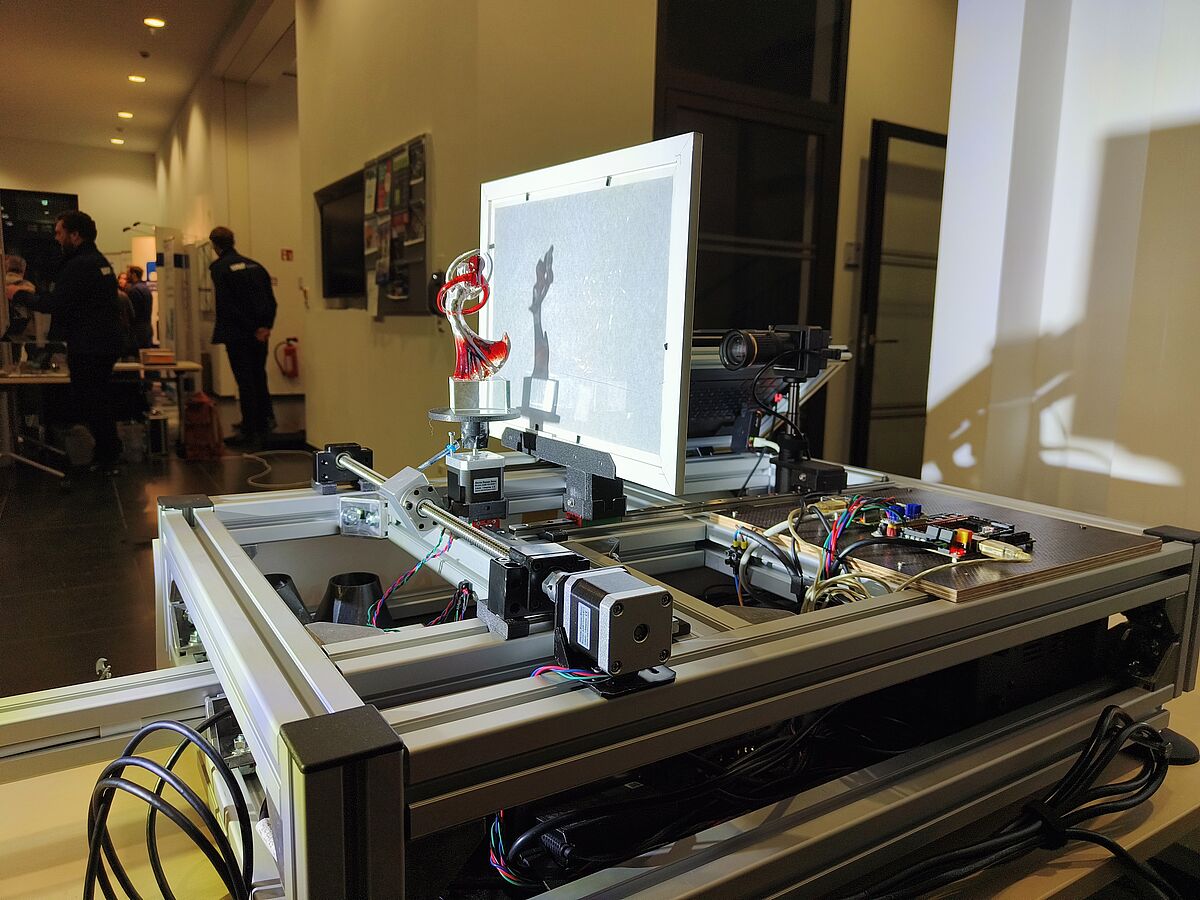
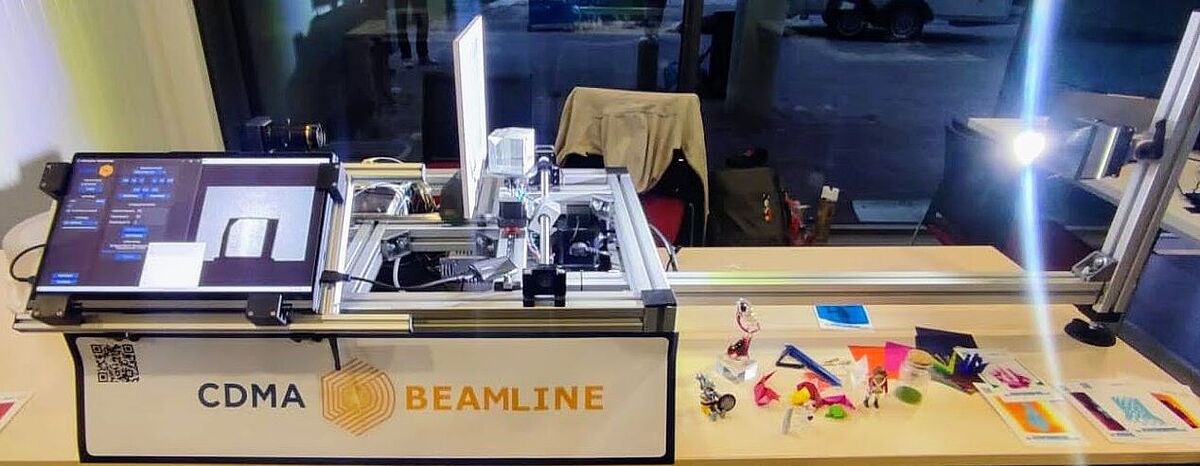
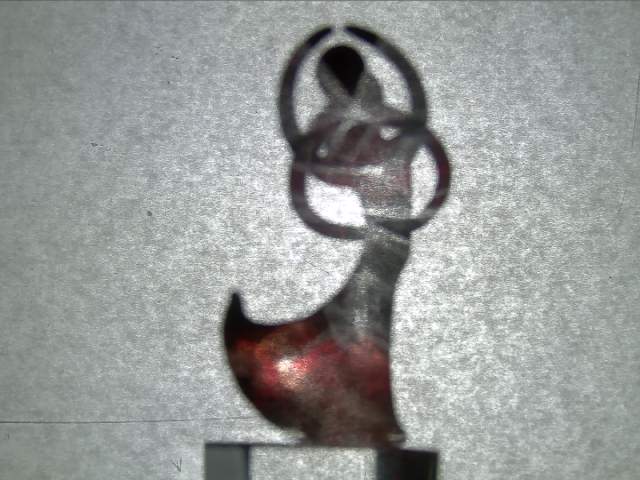
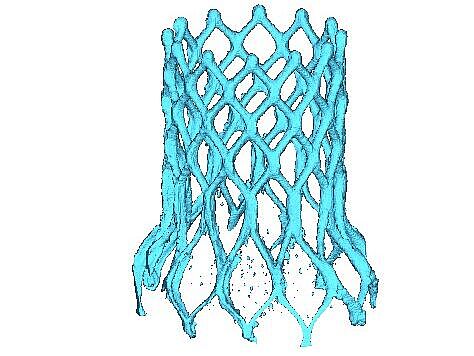
The system is based on a simple and intuitive measurement principle: a powerful LED illuminates a sample mounted on a turntable. As the sample rotates, a high-resolution camera records a series of two-dimensional shadow projections on a diffuse screen. Proprietary software then reconstructs cross-sectional images from these projection data and uses them to generate a three-dimensional volume model. In this way, the system follows the same basic principle as a medical or industrial CT scanner – but with visible light instead of X-rays.
Technical design
The light CT combines established open-source and maker technologies into a versatile system. A Raspberry Pi 4 manages system control, data acquisition, and the user interface. Motion control is handled by a BTT SKR V1.4 mainboard together with TMC2130 stepper motor drivers, enabling precise and smooth rotation of the sample stage. The LED brightness can be finely adjusted via pulse-width modulation (PWM), allowing exposure and contrast to be tailored to different samples.
The control architecture is based on components widely used in modern 3D printer systems: Klipper runs the firmware on the mainboard, while Mainsail provides a web-based interface on the Raspberry Pi. Communication in the background is handled by Moonraker, and Crowsnest enables camera streaming. This creates a clear, capable, and flexible setup for both operation and demonstration.
Use in teaching and science communication
The light-based CT system offers an accessible introduction to tomographic measurement principles and reconstruction algorithms. It enables complex concepts to be communicated in an understandable way and demonstrated in practice. The system is well suited for use in higher education, school projects, and public outreach events such as the Long Night of the Sciences.
The original design was developed by Emanuel Larsson with the goal of making tomographic methods accessible to a broad audience. For use by the Chair, the system was further refined and adapted to specific requirements. The result is a mobile, safe, and versatile demonstration system for a wide range of educational settings. Our poster provides a compact overview of the tomographic principle and its underlying concepts.